Pages

Friday

God and Art Series: Artist seeks to bring positive message

aloquin
Today we are talking with Jen Morrison from Aloquin, a shop on Etsy. You can also find Jennifer on her blog aloquin.

Tell us a little about yourself and your artwork. When and how did you start developing your artistic-self?


I believe artistic development is an ongoing process. We are always inspired by different things we see, and bits and pieces inevitably work their way into our art.

As far as beginning, I was drawing ever since I can remember. It was just something I always loved to do, and even got in trouble in school for doodles all over my desk and inside my math book. It seemed only natural to follow my passion.
aloquin

Have you received any awards or other achievements? Where can people find your work? What teams do you belong to and how did you come up with the name for your shop?

How I came up with my shop name is rather funny. The first job I ever had was at 16, when I worked in the snack shack of the local animal farm petting zoo. I was bored waiting for customers, so I'd brought along paper to write or doodle on, and I was trying to think of interesting words for a pen name for myself. Somehow I got to looking at the back of the packages of food items in the snack shack, and I came across either the word "Aloquin" or a created it from a combination of ingredients on something. Either way, I liked how it sounded, and it's stuck with me ever since.
aloquin

I've won some awards, yes. In High School I won the LILCO - the Energy Wise on Long Island Poster Contest- that was very big for me. It was amazing because everyone was making a huge deal, and I was ecstatic because they were paying such attention to my art. I really felt I could do something in the world from that point on.

This past month of October my entry was chosen for inclusion in the Embracing Our Differences Art Exhibition 2012. This was a very humbling experience because I realized what an important event I was honored to be a part of. All the artists who were chosen got to attend and be recognized at an appreciation celebration, and I earned a beautiful plaque, but more importantly, I was able to use my art to help spread a positive message.
aloquin

What attracts you to drawing illustrations, work with paper (have I missed anything)? How do you gain inspiration for your work?

I suppose the most significant inspiration for my work is the emotion evoked by music. I will listen to songs, and the lyrics will just MOVE me, and I must create in that moment. I will immediately have to start drawing or externalizing my creativeness onto some substrate. My work doesn't become a physical representation of the lyrics I hear, but is more a result of how I feel while listening to the song. I have been creating a lot in Mixed Media lately... it is a freeing and wonderful form of expression.

How have the events of your life affected your art? How has art affected your life?

I have always been drawn (no pun intended) to illustrative work. I enjoy creating ACEOs (Art Cards, Editions, and Originals), working in my art journal, and, more recently, larger canvases/backgrounds. It has simply always been something I've loved to do ... even now, if I go somewhere, I must have a book or paper with me to doodle/create upon if I end up waiting. I can't imagine what my life might have been like if I'd not had my art ...
aloquin

Art has affected my life in the fact that it IS me. I am never not working on something or other. It's as me as eating or breathing ... seriously. I am so grateful to God for giving me this gift. I am inspired by such stories as that of Joni Eareckson [Tada], that I heard of when I was little ... she was paralyzed but still created paintings with the paintbrush manipulated by her mouth. I think that's beautiful!

When did you begin your relationship with God and how? How has your relationship with God affected your art? How has art affected your relationship to God?


aloquin
I am happy to say that, growing up, in a family of born-again believers, I've always had a relationship with God. I remember being passionate about God's love even at age five. I was in the backyard, intent on digging a hole down to the devil so I could witness to him! I was convinced that if he only knew how much God loved him, then he would stop being bad! LOL ... rather naive in retrospect, but not really ... the ideal was sincere, and very real. So many people are caught up in their sinful lifestyles because they just don't know the love of God. I understood at only five years old that we are called to be his light and be used by him to show his love.

How has art affected my relationship with God and vice versa leads into your next question:

Any future goals you'd like to share? Any encouragement for other artists?

My future goals? I believe that God has given me my talent for a reason, and I am open to direction from him for any way that I can use my art to glorify him. I feel my art will one day be used in a big way. I am not saying I'm exceptionally good as compared to others at art, I just feel that I am meant to do something for him with my art, and I am eager to find out what :)

We are eager to find out too, Jennifer. Thank you for visiting with us!


aloquin


Thursday

Unpacking Forgiveness: The Way Up is Down

Few people like conflict. Oh, there are some who seek it out and thrive on it, but generally speaking, most human beings would like a stress-free life with smooth, enjoyable relationships.

Sadly, that is far from reality.

Conflict in every day relationships is common. It seems we can't escape it. But why?

Consider two scriptures from Matthew 18:

1 At that time the disciples came to Jesus and asked, “Who, then, is the greatest in the kingdom of heaven?”2 He called a little child to him, and placed the child among them. 3 And he said: “Truly I tell you, unless you change and become like little children, you will never enter the kingdom of heaven. 4 Therefore, whoever takes the lowly position of this child is the greatest in the kingdom of heaven. 5 And whoever welcomes one such child in my name welcomes me.

And,

 21 Then Peter came to Jesus and asked, “Lord, how many times shall I forgive my brother or sister who sins against me? Up to seven times?” 22 Jesus answered, “I tell you, not seven times, but seventy-seven times.[Or seventy times seven]23 “Therefore, the kingdom of heaven is like a king who wanted to settle accounts with his servants. 24 As he began the settlement, a man who owed him ten thousand bags of gold was brought to him.25 Since he was not able to pay, the master ordered that he and his wife and his children and all that he had be sold to repay the debt.26 “At this the servant fell on his knees before him. ‘Be patient with me,’ he begged, ‘and I will pay back everything.’ 27 The servant’s master took pity on him, canceled the debt and let him go.28 “But when that servant went out, he found one of his fellow servants who owed him a hundred silver coins.[i] He grabbed him and began to choke him. ‘Pay back what you owe me!’ he demanded.29 “His fellow servant fell to his knees and begged him, ‘Be patient with me, and I will pay it back.’30 “But he refused. Instead, he went off and had the man thrown into prison until he could pay the debt. 31 When the other servants saw what had happened, they were outraged and went and told their master everything that had happened.32 “Then the master called the servant in. ‘You wicked servant,’ he said, ‘I canceled all that debt of yours because you begged me to. 33 Shouldn’t you have had mercy on your fellow servant just as I had on you?’34 In anger his master handed him over to the jailers to be tortured, until he should pay back all he owed.35 “This is how my heavenly Father will treat each of you unless you forgive your brother or sister from your heart.”

Now compare the two stories. What trait would be present in a child that was not present in the servant who owed his master a lot of money?  

Humility. Does that surprise you or did you guess? 

In his book Unpacking Forgiveness: Biblical Answers for Complex Questions and Deep Wounds, author Chris Brauns writes that children in the ancient Middle East were expected to "be seen and not heard". They did not seek status. Children had a humble position in society. They knew their place.  

This is not to say that the followers of Christ are to not try to succeed or achieve greatness for the kingdom. This means that in light of God, our Father, we are to know our place. We are to remember who gave us everything we have.  "Jesus encouraged the disciples to pursue greatness," Brauns writes, "and the way he taught them to pursue it was by serving one another, by being truly humble."

How this fits with forgiveness is evident in the second passage of scripture. If the servant who owed his master that huge amount of money had been humble (and truly grateful, I might add), he would have cancelled the debt, or would have been more patient with other servant who owed him such a small amount. After receiving forgiveness for so much, you would think that the smaller amount would mean nothing.

"True humility nips conflict in the bud. In one way or another, selfish pride causes all quarrels and fights (James 4: 1 -10; Matthew 7: 1-5). Second, if we are truly humble, then when we do have conflicts, they will be resolved far more quickly," Brauns writes.

Do you remember the last conflict you had? Were you humble or not? How did that go?

Being humble is not easy for anyone. At the base of humility is the absence of pride, but pride can take many forms. The thing to remember is that pride "is not just an inflated opinion of oneself," Brauns writes. "Pride is any way of putting self into the central focus."

Wow. Or should I say "ouch"?  Brauns says that people who are overly critical, insecure, shy, sensitive, presumptuous, impatient with others shortcomings, easily embarrassed or those who worry a lot are examples of those who struggle with pride. All of these shortcomings, plus more overt displays of pride, can cause conflicts and can prevent the resolution of conflicts (p. 82).

No wonder we struggle so much. Often, in the church, displays of humilty are shown by calling ourselves "wretches" or saying that we are nothing. This does not follow the Biblical definition of humility because it puts the focus right back on ourselves.

Although pride is difficult to overcome, it is possible. I believe that if Jesus did not mean for us to overcome sin he would not have told us to do so, but we first must give the Holy Spirit control of our hearts. I also like what Brauns recommends in this chapter: "The only way to grow in humility truly is to take our eyes off ourselves and meditate on the beauty and glory of the Lord Jesus Christ."

Brauns recommends reading and meditating upon Isaiah 40 as a way to help develop humilty. I also recommend the Psalms, any of the church canticles and Job 40 and 41.

"Biblical humility is increasingly seeing ourselves as completely dependent on God. It is serving others for God's glory. We achieve humility only by seeing and savoring Christ. The more we see Christ, the more we will be truly humble, the more conflicts we will avoid, and the more easily the ones we do encounter will be resolved," Brauns writes.

That is not bad advice.

Next week we will review chapter seven, "Unpack with Great Urgency."

Wednesday

Dealing with holiday stress

Christmas has always been a special time. During my childhood there were special art projects to do at school, yummy cookies to help decorate and eat, music programs, special church services, presents, fun with my cousins, and, of course, vacation from school. That's always a plus.

As I grew older, I became increasingly aware of the drama that surrounded the Christmas season. I didn't notice it so much in college, but when I got married and moved away from home, I realized how hectic it could be, especially since we did not have money. Before that, I had never realized that Christmas could be such a pain between the ears.

It's a good thing that I did not realize the stress surrounding Christmas before adulthood. I credit my parents for that. It is because of this that I have sought an answer to bringing the fun and peace of the holidays back into my life.

This has not been easy at all. The stress of the holidays can make you crazy. For years, I have struggled under the belief that I had to do everything people wanted me to do, give gifts, baked goods and/or cards to relatives, friends and acquaintances; participate in every church activity and make my children happy to boot. It was a terrible burden - one that I did not really become aware of until a few years ago. I just thought that being dog tired and cranky was part of the holiday season for adults. Do you feel that way this time of year?

This year I've rebelled against all of that. I'm really tired of allowing the world's expectations of what makes a good holiday to hijack my celebration of Christ's birth. You'll recall that I wrote a post earlier this year about not shopping in stores on Black Friday. Later on this season, I realized that this decision was a culmination of many things that the Lord has taught me over the last few years in order to bring Christmas to my heart in a more refreshing way.

So far, it seems to be working. And, it's a shock.

So, what is the difference?

1. Our family bought an Advent wreath. This turned our focus upward. Every Sunday we've gathered around the candles and have prayed a prayer asking the Lord to come.

2. I'm praying the Advent liturgy of the church every day and night. This is not to say that I'm ultra pure because of this. I really need this to center my focus. This liturgy is found in the book of "Christian Prayer" on Amazon.

3. We did not shop in stores on Black Friday. What more terrible way to start off the Christmas season is there than fighting - sometimes quite literally - your fellow human beings at stores for senseless merchandise at ungodly hours of the day and night? Staying at home and making gifts and shopping online a little bit at normal hours made the start of the season much more relaxing.

4. We have changed our idea of gifting. We are only buying gifts for people who are close to us. Everyone else gets a hearty Merry Christmas. We may send cards to far away friends and family who, again, are close, but for the others we can always greet them on Facebook.  One thing I need to do is spread out making homemade gifts throughout the year. I've got three crochet projects still in the yarn stage that I really want to get done by Christmas, but there's no pressure! That will have to change next season even though I am enjoying myself.

5. We are not participating in a lot of outside activities. In order for us to participate in an activity, such as a Christmas program, the activity has to involve our family members, preferably in home-centered activities. Many of our activities are in fact centered at home, and we are finding that this works out much better. We've had a tree decorating get together and we plan to decorate cookies as a family.

6. We are going to give cookies, or perhaps bread, to our neighbors. Although we live in a very small town, more of a village than a 'town,' we really don't know the people who live around us very well. Nonetheless, they are all good neighbors, and I want our family to do something nice for them to show that we appreciate this.

I hope my words have helped you today. Maybe you feel frazzled. Maybe you have some other suggestions that will help us this season. I'd love to hear what you have to say.

Tuesday

Advent season emphasizes waiting

When I was a child, Christmas meant the birthday of Jesus, wonderful food, getting to see my cousins and, of course, gifts.

Do you remember what it was like as a child waiting for Christmas? It was almost excruciating. 

On Christmas Eve our family would get together, eat dinner, attend a Christmas service and then go to one of my aunts' houses. There we would unwrap gifts - we had a large family so we would draw names - and eat the delicacies that our mothers had prepared. Since my family lived a couple of hours away from everyone else, we would stay and spend Christmas morning with my Uncle Gary, Aunt Jeanne and my cousins Joy and Jamie. Since Jamie was so little, Joy and I would snuggle down under the covers in her room, talk for a bit and then as I was starting to drift off my younger cousin would start hearing things.

"Santa's on the roof," she would whisper loudly.

"What?" I asked, suddenly awake.

"I heard reindeer," she said.

We both became quiet and strained to hear the reindeer hooves on the roof.

"I don't hear anything," I said and rolled over. Again, as soon as I was about ready to dream of sugar plums like the children in "The Night Before Christmas," my cousin would shake me.

"I heard them this time," she said.

"No you didn't," I said.

"Yes, I did!"

Ignoring her, I rolled over and realized that the light in the living room was still on. I could hear our parents laughing and there were some clunking noises but the sound wasn't coming from the roof.

"Our parents are still awake," I said.

"What are they doing?" Joy said.

"I don't know," I replied, pushing back the covers. "But I gotta go to the bathroom."

We jumped out of bed in a flash and ran down the hall giggling. We ran into the bathroom and Joy slammed the door. When we came out, the figure of my aunt loomed before us.

"Why are you awake?" she asked.

"We had to go to the bathroom," Joy said innocently.

I noticed that it was really quiet out in the living room.

"Go back to bed," Aunt Jeanne said. "Otherwise Santa will not come."

That was all Joy needed. She ran down the hall and I followed, now feeling skeptical about the entire Santa Claus thing for the first time. I laid in the dark after that, listening to the clunking out in the living room, thinking about the Grand Deception. As I was about to drift off to sleep, Joy kicked me on the back of the legs.

"I can't go to sleep," she whispered.

"Try," I said. This time sleep did not escape me. The next thing I knew, it was morning and we were both awake before the crack of dawn. We had strict orders not to get up before 7 a.m. so we waited again.

There was a good "haul" that year. I received my first bicycle. It was definitely worth the wait. 

The Advent season emphasizes waiting. We are waiting for the Lord to return and we think about the Jews waiting for their Messiah all those years. There were literally thousands of years that passed between the promises of the Messiah and the actual coming of Jesus. Now more than 2,000 years have passed since Christ's ascension and promise to return to earth. We're still waiting. It's been a long time. Will the Lord still find us anticipating his coming like we did as children awaiting the arrival of Santa Claus?

Although the imminent arrival of Santa Claus on Christmas Eve is folklore that parents pass on to their children to add excitement to the season and to get their children to behave, the promise of Christ's return to earth is true. We believe this by faith and because of the witness of the people who walked with Jesus and heard his words firsthand. As we believe, our faith increases and we look forward to the time when Christ will come and make everything right with the world.

Here is the Advent prayer that our family prayed on the second Sunday:

Lord, our God, we praise you for your son, Jesus Christ, for he is Emmanuel, the hope of all people.
He is the wisdom that teaches and guides us.
He is the Savior of us all.

O Lord, let your blessing come upon us as we light the first and second candles of this wreath. May the wreath and its light be a sign of Christ's promise of salvation.
May he come quickly and not delay.
We ask this in his holy name.

Amen
Waiting

We light a candle today, a small dim light against a world that often seems forbidding and dark. But we light it because we are a people of hope, a people whose faith is marked by an expectation that we should always be ready for the coming of the master. The joy and anticipation of this season is captured beautifully in the antiphons of hope from the monastic liturgies:

See! The ruler of the earth shall come, the Lord who will take from us the heavy burden of our exile.
The Lord will come soon, will not delay.
The Lord will make the darkest places bright.
We must capture that urgency today in the small flame of our candle. We light the candle because we know that the coming of Christ is tied to our building of the kingdom. Lighting the flame, feeding the hungry, comforting the sick, reconciling the divided, praying for the repentant, greeting the lonely and forgotten - all of these works hastens his coming.

 - Source unknown

May we eagerly await Christ's coming with the anticipation of a child. I pray that this Advent season will prepare you for a wondrous Christmas.

Thursday

Unpacking Forgiveness: More than a Feeling

Almost every summer during my childhood, I spent a week with my cousin. This cousin and her family are devout Christians so spiritual training was a priority in the home. Along with many other fond memories, I remember bedtime when my aunt would sit on the side of the bed, tuck us in and then my cousin and I would recite the Lord's Prayer. After this we would ask God to bless everyone we knew by name. It was quite the little prayer meeting, but reciting the Lord's Prayer at such a young age helped lay the foundation for learning to forgive.

Forgive us our trespasses as we forgive those who trespass against us ...We learned everything in the traditional King James back then.

As I said, this scripture laid the foundation for learning to forgive, so much so that when I began to suffer deeply-felt hurts in the junior high world, I didn't question my youth pastor when he advised me to forgive. I didn't want to go to hell, after all. And I wanted God to forgive me too. Part of that advice included going to the person who had hurt me to tell them how I felt. Though painful, this approach usually worked out so that the person apologized and we became friends again. I didn't like this process very much, but it seemed biblical to me so I did it.

This was in the mid-80s. About that time, according to author Chris Brauns in his book Unpacking Forgiveness: Biblical Answers for Complex Questions and Deep Wounds, a book called Forgive and Forget: Healing the Hurts We Don't Deserve by Lewis Smedes was published. "This book sold hundreds of thousands of copies," Brauns writes. "It is both representative of, and responsible for on some level, a great deal of wrong Christian thinking about forgiveness."

Brauns continues:

Smedes essentially defined forgiveness as ceasing to feel resentment or anger over an offense or perceived offense. The way he views it, forgiveness is a private strategy for defeating bitterness and hate. L. Gregory Jones summarized: '[According to Smedes,] forgiveness becomes a means of being 'healed' of your 'hate,' of which Smedes argues people have a right to be healed. Smedes internalizes and privatizes forgiveness by making it primarily an activity that goes on within individual persons' hearts and minds.

It's weird. I remember this shift. I don't recall exactly when it happened but it suddenly became okay to forgive someone in my heart and to try to stop feeling angry (and try to hide the anger until it stopped) without going to that person and actually talking to them. Brauns calls this version of forgiveness "therapeutic forgiveness," because in it Smedes has turned forgiveness into an emotion from which we have a right to be healed. "He redefines forgiveness," Brauns writes. "According to Smedes, forgiveness becomes an emotion rather than a transaction or commitment between two parties. Specifically, forgiveness becomes the universal antidote for bitterness."

Remember Brauns' definition of forgiveness? Forgiveness is a commitment by the offended to pardon graciously the repentant from moral liability and to be reconciled to that person, although not all consequences are necessarily eliminated.

So what's wrong with the therapeutic view? I can speak from my own experience about what is wrong with it. It's not good to be angry or bitter. Since I have employed this method, I have seen many friendships fade - either because I chose to drift away or they did. People also quit being truthful about being offended. I remember practically having to drag the information out of one of my acquaintances when I offended her, otherwise she would ignore me for months. As I grew older, people even began to hide information about who I had offended (or seemingly offended) rather than try for reconciliation. This is a "wonderful" environment for gossip to flourish, thus ruining reputations and causing people who aren't involved in the alleged problem to have hard feelings toward people they may or may not even know. This environment breeds paranoia and an unwillingness to become close to others.

Conversely, my husband and I have a very healthy relationship. We tell each other when we feel we have been wronged. Bringing it out in the open helps us analyze what we are feeling and the viewpoint of the other person. Once this is done, we kiss and make up. The problem is over as far as we're concerned. Why do I have so much trouble doing this with other people? I see it as a lack of love in my heart because of the hurt I've suffered in the past.

The therapeutic view says that we are to forgive automatically. We are to immediately shut down any negative feelings. Yet, if we are truly honest with ourselves, we know that this is virtually impossible. Buried feelings reap a bitter harvest. It appears that the biblical view, which includes a two party agreement and reconciliation is much healthier for ourselves, the other person, and for the community at large.

Brauns' book has a great chart comparing and contrasting the biblical and the therapeutic view of forgiveness. He also offers sound reasons as to why the biblical view is the best way. I urge you to purchase the book or borrow it from a local library*. I have simply summarized the chapter here and used my own experiences to illustrate Brauns' view. Maybe you'll have a different outlook after reading the chapter yourself. I'd love to hear what it is.

*If your library does not have the book, ask your librarians if they will obtain it through an inter-library loan. Our librarians here in town are quite happy to do this. Yours probably will be too.

Wednesday

An Old Tradition with a New Twist

Outside the church, this Christmas season began for many on Thanksgiving Day at 8 p.m. when major stores began their Black Friday sales. Here at Yahbut: AL  I wrote about rebelling against the unmitigated display of commercialism and greed by staying home. My family did that - well, the boys took their grandfather to a national park, but they didn't go shopping. My mom and I, on the other hand, stayed home and made Christmas presents while Mike did stuff around the house. Making presents on Black Friday was a lot more fun and relaxing than going to the store to wade through hordes of people.

In light of my rebellion and because I'm focusing my devotional time on the daily lectionary, our family began a new tradition this year. We fashioned an Advent wreath. On December 2, when the church at large began its Advent celebration, we lit a candle just before eating our Sunday meal. Many churches have advent wreaths in the sanctuary. They light a candle on each of the four Sundays before Christmas and read a little about what it means.

Here is a picture of ours:


Well, I must confess, it's more like an Advent number line but we still have the candles.

Not being Catholic and having grown up in a lower Protestant denomination, Advent wreaths were not part of my heritage. In our church, these wreaths emerged as part of Christmas celebrations sometime in the early 1990s so I had very little understanding of their symbolism. As a result, when I bought my candles at IKEA, I purchased four purple candles and a white candle. I also bought a porcelain rectangular platter upon which to place them - thus, the number line analogy. This is better for my table, actually, rather than having a wreath. So, I'll probably get some evergreen and place it on the platter in order to represent eternity. That's what I get for not doing my research before buying, but this is what I'll stick with for now.


No one really knows the origin of the advent wreath, but traditional sources say that it stems from Germany. The Catholic Education Resource Center has this on their website:

There is evidence of pre-Christian Germanic peoples using wreathes with lit candles during the cold and dark December days as a sign of hope in the future warm and extended-sunlight days of Spring. In Scandinavia during Winter, lighted candles were placed around a wheel, and prayers were offered to the god of light to turn “the wheel of the earth” back toward the sun to lengthen the days and restore warmth.

In the Middle Ages, Christians adapted this tradition for their own use. Christians made "Advent wreathes as part of their spiritual preparation for Christmas. After all, Christ is 'the Light that came into the world' to dispel the darkness of sin and to radiate the truth and love of God (cf. John 3:19-21). By 1600, both Catholics and Lutherans had more formal practices surrounding the Advent wreath," according to the Catholic Education Resource Center (see above link).

Advent wreaths are circular to represent eternity (Well, mine is straight, but a number line goes on into infinity so I guess my family is okay there). They are usually decorated with evergreens in order to represent life and resurrection. The candles - three purple, one rose - represent the four weeks of Advent. I have four purple candles because Ikea did not have rose-colored candles.

The purple candles in particular symbolize the prayer, penance, and preparatory sacrifices and goods works undertaken at this time. The rose candle is lit on the third Sunday, Gaudete Sunday ... (which) is the Sunday of rejoicing, because the faithful have arrived at the midpoint of Advent, when their preparation is now half over and they are close to Christmas. The progressive lighting of the candles symbolizes the expectation and hope surrounding our Lord’s first coming into the world and the anticipation of His second coming to judge the living and the dead.

Later adaptations included a white candle placed in the center of the wreath. This candle, often called the Christ Candle, represents Jesus and is traditionally lit on Christmas Eve.

On Sunday, when our family gathered to watch the Broncos beat Tampa Bay and win the AFC West (yea!), before dinner I told them a little about the Advent, uh, number line, and talked about the joy of Christmas. Because of our culture, I told them, we think of Christmas as a time for giving gifts, but really the gifts are symbols of what the wisemen gave to Jesus. More importantly, they also represent Jesus, God's greatest gift to us. The word Advent means 'coming' and so this Christmas season our candles, which represent the light of Christ, will help us wait for his coming. According to my research, I don't think this was actually the emphasis for the first Sunday, but this is what I felt led to do.

We then lit the candle and Mike prayed this prayer that we found on the Catholic News Agency website. On the website the prayer is divided into two parts. We combined the two.


Let us pray that we may take Christ's coming seriously.
All-powerful God, increase our strength of will for doing good that Christ may find an eager welcome at his coming and call us to his side in the kingdom of heaven, where he lives and reigns with you and the Holy Spirit, one God, for ever and ever.

Lord God, I sense your power, your might and I stand in awe, painfully aware of how poor and weak I am before you.
As I begin this Advent journey, teach me to turn to you in my fear and sorrow.
I don't want to keep making my heart hard against you turning a deaf ear to your invitation.
Only you can help me to soften, to be like the clay in your gentle potter's hands.
Amen.

I plan to write more on Advent this season. It turns out that there is a lot of information on this celebration. May you have a happy Advent as you prepare your hearts for Christ's coming.


Monday

Giving someone water for Christmas ...

Hey, everyone. Here's the most recent e-mail from Dr. Joe with Compassion for Africa.

Are you searching for a Christmas gift for that person in your life who’s tough to buy for? How about honoring them with the gift of a well—or part of a well? Amazingly, a well in northern Ghana can be dug for $3,200.

Wells are Dug One Shovelful at a Time

Compassion for Africa hires local labor to dig wells by hand. One of the many benefits of a hand dug well (see picture above) is it provides jobs for local people. By engaging local labor, it gives local people an opportunity to participate in the well’s construction. In this way local ownership of the project is fostered and wells are dug “with” local communities rather than “for” them.

If soil is sandy, an entire well can be dug by hand; but, in cases where the soil is extremely rocky, an augur is brought in (hiring an augur significantly increases the cost of a well). If large rocks prevent further digging, dynamite is used. Usually, wells need to be dug no deeper than 40 feet, even in the desert-like conditions of northern Ghana. After a well is dug, it is lined and then a pump is installed. The top of the well is sealed with concrete that forms a trough down which excess water runs and is caught in one or two small holding areas from which animals can drink water that would otherwise be lost.

How One Well has Benefitted the Galenzewu Community

One well services around 1,000 people a day. In the arid Galenzewu community near Tamale, Ghana, however, it’s more like 1,500 or more. When I was in Ghana this last summer, I asked some of the people in the Galenzewu community how the well CFA sponsored has helped their lives.

A woman with a small baby told me before the well was dug she walked 3-4 hours a day to fetch water. She expressed heartfelt thanks that God has used the Church of the Nazarene to bring clean water to her village. She said she has not only received spiritual help from Christ as her Living water, but the water from the well has cut down problems of cooking, bathing, and washing clothes. Life is much better for her now, she says, because her children are healthier and experience diarrhea much less frequently.

One man told me: “In Christ there are many blessings. Water was a very big problem for us before the Church of the Nazarene came to our village. We had to travel very far for water and the people near the water made us pay for it even though cattle drank from it and defecated in it.”

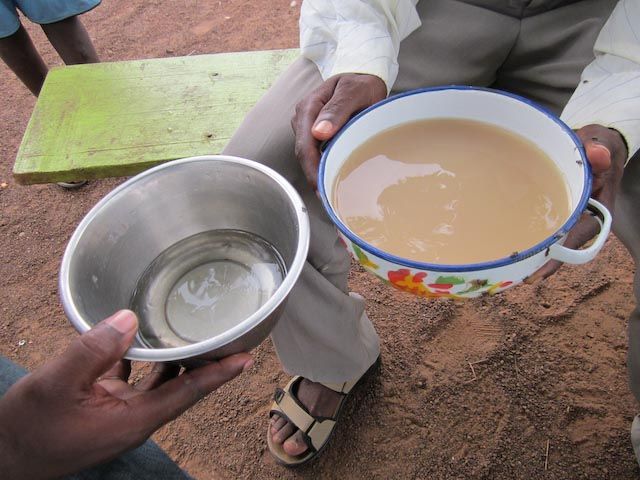
The Galenzewu community’s old source of water was so dirty that before drinking it they had to wait over night for the sediment to settle. And, even then, the dirt never completely settled. As a result many children got diarrhea, ring worm, and died. Water used to be the most difficult challenge to the village of Galenzewu. Since the digging of the well, the people in Galenzewu have been healthier, there is much less diarrhea, and fewer children are dying. The people in Galenzewu are also very careful to conserve the water in the well, using it only for drinking and cooking. Both men and women told me many times: “Our words cannot express how truly grateful we are for the well.”

When I visited with Galenzewu’s village chief, he told me, “Water is everything. When a guest visits my compound (see picture above), he offers water even before food.” He asked rhetorically, “What does your visitor think if you offer him dirty water? Now I am proud to have guests and offer them clean water.”

As Christians we believe that clean water promotes health and saves lives which God created in love. Jesus said, “Whatever you did for the least of these [such as giving the thirsty a drink], you did for me” (Matthew 25:40).

God bless you and your families as you consider gifts for those on your Christmas list. A gift of $10, $25, $50, or $100 in honor of a loved one will give the gift of clean and living water to the thirsty in Ghana this Christmas.
Joe Gorman
Executive Director, Compassion for Africa

If you are able to give toward any of our projects, please send a check made payable to Compassion for Africa, 412 West Bayhill Drive, Nampa, ID 83686 and tell us which project you’d like your gift to go toward.

100% of all monies given to “Compassion for Africa” (www.compassionforafrica.org; www.facebook.com/compassionforafrica) go directly to the project for which you designate them. There is no administrative overhead as any travel, transport, printing, postage or other costs associated with “Compassion for Africa” are paid through separate donations. Compassion for Africa is a registered 501(c)(3) with the IRS.

You can also donate through PayPal, on the Compassion For Africa website.


Wednesday

Unpacking Forgiveness: A Definition for Christians

When I worked as a newspaper reporter our staff had frequent meetings to decide what topics we wanted to write about in the coming weeks. During the holiday season we tried to run special articles about gift giving, what there was to do around town and also articles about how to get along with family members. Why? Because this is the time of year when families get together. As we know, families don't always get along.

The holidays bring high expectations. Typical holiday specials on television and in movies usually show families getting together, fighting and then by the time Christmas morning rolls around everyone is happy and in love once again. Broken relationships are magically healed and everyone gets what they want. This is all well and good but it is just not realistic. Sometimes when families get together there is a palpable tension. Snide remarks are made, unpleasant memories resurface, people act selfishly. This can irritate others so much than they may even come to blows.

Forgiveness is truly an important ingredient for happy family gatherings.

As Christians, we are expected to forgive like God forgives. Last week I wrote about the definition that author Chris Brauns developed for forgiveness in his book "Unpacking Forgiveness: Biblical Answers for Complex Questions and Deep Wounds" This definition is:

God's forgiveness: A commitment by the one true God to pardon graciously those who repent and believe so that they are reconciled to him, although this commitment does not eliminate all consequences (p. 51).

"...We can adapt the above definition of God's forgiveness to a general definition for human forgiveness," Brauns writes. "Forgiveness: A commitment by the offended to pardon graciously the repentant from moral liability and to be reconciled to that person, although not all consequences are necessarily eliminated."

The word "graciously" is important. As Christians, we should always be willing to forgive those who have offended us just as Jesus offered forgiveness when he was dying on the cross.

According to this definition, forgiveness is also a commitment, or, a "promise to pardon another," Brauns writes. He quotes Ken Sande, author of "The Peacemaker":

"...You promise not to dwell on or brood over the problem or to punish by holding the person at a distance. You clear the way for your relationship to develop unhindered by memories of past wrongs. This is exactly what God does for us, and it is what he calls us to do for others."

I think that the most important part of this definition is in the phrase "pardon graciously the repentant." In other words, forgiveness requires a two-party agreement. I cannot forgive someone who does not repent. I can choose to let things go and not hold things against people but true forgiveness does not happen unless the offender comes to terms with what he or she did and asks forgiveness.

So, offenders must repent. This means that they do not commit the offense again. Biblically speaking, "to repent means to change behavior as a result of a complete change of thinking and attitude" (p 57). As Christians we must always freely forgive the repentant because that is what God does for us.

Once we forgive, reconciliation follows, but this does not mean the offender will not suffer consequences, nor does it mean that the relationship between the offender and the offended will become as it was. Sometimes when we forgive in a difficult situation, the relationship with that person will not go back to its original state. For instance, when I wrote about my old boyfriend who asked for forgiveness this did not mean that we had to get back together. Far from it. There was a reason I broke off the relationship. That reason was not going to change even though I forgave him. Getting back together wasn't possible.

You may also be in a situation in which you are asked to forgive, but you just cannot bring yourself to do that. It is against all logic, at times, to forgive, yet  people have done so in unthinkable situations. One of my favorite stories is about Corrie ten Boom, who helped hide Jews from the Nazis during World War II. Corrie and her family were eventually sent to a concentration camp for this offense. After her release and the war ended, Corrie traveled around the world telling people about her experience about sharing God's love. Once when she was invited to speak in Germany, a man approached Corrie after her talk. She recognized him as one of the guards in the concentration camp who was particularly cruel. Remarkably, this man had met Jesus and asked Corrie's forgiveness. She paused for a bit because this was very difficult for her and then finally extended her hand to shake his as a gesture of forgiveness. She described how freeing the moment was in her book "The Hiding Place."

"Perhaps nothing is more glorifying to Christ than Christians forgiving others as God forgave them," Brauns writes. "...Graciously, willingly, and freely, they should offer a costly present to any who offend them. Those who do repent and unwrap the offered package will find forgiveness and reconciliation inside."

Next week we'll review chapter five, "More Than a Feeling."


Unpacking Forgiveness: Defining Forgiveness

Anyone who has had to suffer from repeated hurts inflicted by another person has learned that forgiveness is difficult to define. much less achieve. Does that sound like a Christian response, given what we are taught about forgiveness?

Often, in church, or by other believers, we are told that in order to make the pain go away we just need to do what Jesus' said and forgive - over and over, if necessary (Matthew 18: 21 - 35 ). This is true, of course. Our Master Jesus would not have said this if it were not the way to go, but how is this lived out? In order to do this, we must gain a more in depth understanding of forgiveness if we are going to be forgiving people. There is no simple 'how-to' in forgiveness. It can take time - even years - to work through the hurt and anxiety caused by others.

In his book "Unpacking Forgiveness: Biblical Answers for Complex Questions and Deep Wounds," author Chris Brauns writes that "the Bible says far more how God forgives people than it does about how people should forgive people (p. 45)." So, in order to develop a more in depth working definition of forgiveness, we must study to scripture to find out how God forgives us.

Brauns defines forgiveness this way:

God's forgiveness: A commitment by the one true God to pardon graciously those who repent and believe so that they are reconciled to him, although this commitment does not eliminate all consequences (p. 51). 

In his book, Brauns offers an example of forgiveness from his own parenting experience. However, I would like to tell you one of my own so that I can go more in depth. I believe this is at the heart of what the chapter is discussing.


When my two oldest children were small -  Jonathan the youngest at the time of this event, about 16 to 18 months old - we lived in a parsonage that was connected to the church of which my husband was pastor. Our backyard stretched the length of the two buildings and was a nice place for the kids to play. The only drawback was that there was no fence between the street and our yard, so I had to be out there supervising the entire time they were outside. Jonathan, my fiery little redhead, loved to challenge me; he knew that he wasn't supposed to leave the yard and run out into the street. On this particular day, he and Andrew, the oldest, were playing with a ball. Jonathan did not catch it and it bounced past him. The next thing I knew, he was running full tilt toward the street. In his mind he thought he would just run out and bring the ball back. What he did not see, however, was a city bus heading in our direction.

Halfway across the yard, I yelled and ran after him as fast as I could, catching him at the curb. I grabbed his arm just as the bus reached our location. Fortunately, it was slowing down to stop in anticipation of what could have happened. I scooped Jonathan up into my arms and marched him inside with Andrew in tow. I then made the experience a little painful for him so that he would remember to never do that again. By the time the experience was over, I think Jonathan understood that what Mom said actually meant something and by that evening we were all well and happy. I had explained things as best I could and Jonathan said he was sorry. The ordeal was over and Jonathan never ran into the street again.

Now, I love my kids more than life itself, but I do not tolerate disobedience. It is for their own good. I did not spend all of those hours in painful labor to have them disobey me and get hurt or killed. I want them to grow into responsible adults who make a contribution to society and to the Kingdom of God - so I disciplined them. In the end we always talked about the situation so that I could make sure they knew that I loved them.

That's how God is with us. Brauns writes:

"God's forgiveness is gracious. He offers forgiveness freely. This is not because forgiveness is free in terms of cost. It is a very expensive gift that can be offered freely because, motivated by love, God sent his one and only Son to pay the price for it."  After disciplining my children, there was always a time of talk and forgiveness. Raising them is costly, in time, pain and expense so my forgiveness is not free, though it is offered freely.

"God's forgiveness is a commitment." When God forgives us, he makes a commitment that we are pardoned from our sin and that it is no longer counted against us." It would have been a lot easier at the moment not to discipline any of my children. I could have let them just run wild while I did something I enjoyed, but that is not what parenting is all about. When we have a child (or adopt one) we make a commitment to God and to that child to raise it in a healthy way. When our children disobey, we should be committed to disciplining them and forgiving. We should never hold what they did against them after the incident is over (unless it is a gentle reminder to not repeat the same action - "Do you remember what happened last time?").

"God's forgiveness lays the groundwork for and begins the process of reconciliation. When God forgives us, our relationship with him is restored." The talk after the discipline (usually when things had calmed down and we could sit in a quiet place) was the beginning of reconciliation between the offender (Jonathan in the above case) and the offended party (myself).

"Not all consequences are immediately eliminated. God disciplines his children as a father disciplines his children (Proverbs 3:12)." Just because I love my children doesn't mean that they don't need to suffer the consequences for their actions, even if they sincerely apologize after the offense. When they are little it means a time out or other consequence. As they grow the consequences change - some are contrived and some are natural. For instance, if one child were to say or do something that offended a sibling, that sibling may not be inclined to speak to the offender for a while. This is a natural consequence. I would expect, however, that once the situation calmed down that the relationship would be restored. Unfortuntely, I cannot protect my children from every consequence of their actions, especially as they enter the adult world. Life isn't like that. Forgiveness is not either.

So now we developed an understanding of how God forgives. Next week, we will define forgiveness for Christians. Please feel free to discuss this in the comment section and Happy Thanksgiving to those who are celebrating it.


Tuesday

New items at WritingPlaces

I just added two new accessories for winter to WritingPlaces on Etsy.

Here is a warm slouchie beanie made of 100 percent wool. I used a very nice wool yarn produced by Lanarota Filatura of Italy. My granddaughter Tayler is modeling for me.


And a headband made from the same yarn. My pattern was purchased from The Crochet Dude.


I love this color. It's so bright and cheerful. It will make you stand out in the crowd on a dull winter day.

Monday

I'm rebelling this year ...

I'm rebelling this year.

Well, at least for the most part.

And against what am I rebelling? The hype of Black Friday and Christmas shopping in general.

I realize that as an Etsy seller that this puts me in a precarious position because I hope that people will buy from my store this holiday season. That would be great. I also plan to buy gifts too. I'm just not going to join the hype.

This year the time that Black Friday shopping will start has been pushed back to new heights of ridiculousness - 8 p.m. on Thanksgiving Day in most stores and at 6 a.m. in one ad that I've seen. What will it be next? Stores offering free turkey sandwiches and cranberry juice to everyone who chooses to shop rather than stay at home giving thanks?

I'm not the only one who thinks this way. Many workers from Walmart are going to strike on Black Friday at the probable risk of losing their jobs. This Black Friday strike is meant to draw attention to other issues that the company's employees are angry about such as low wages, high insurance premiums and "alleged retaliation from management," according to Bloomberg Business Week. Here is a quote from an article on the subject:

Along with Target (TGT) and Sears (SHLD), Wal-Mart has plans to open retail stores at 8 p.m. on Thanksgiving night. Employees said they weren’t given a choice as to whether they would work on Thanksgiving and were told to do so with little warning. “They don’t care about family,” said Charlene Fletcher, a Wal-Mart associate in Duarte, Calif. She said she is expected to report for work at 3 p.m. on Thanksgiving Day. The workers said that when they complain about scheduling and other problems, management cuts their hours or fires people. - BloombergBusinessWeek


With the national unemployment rate at 7.9 percent (and growing if all of the striking Walmart employees lose their jobs), the economy in a long-term recession, and the Northeast recovering from a devastating hurricane, why are these stores pressuring the American public to shop? Why are they also interrupting one of our most important holidays, a day in which Americans need to stop and give thanks for all of their blessings, in order to rush into Christmas, another important holiday that has been culturally reduced to a gift-giving, tinsel-laden frenzy.

As one who enjoys shopping, believe me, I understand why people shop on Black Friday. The deals at the stores are pretty amazing. However, this year, I'm going to stay home and digest my Thanksgiving dinner in relative peace. I'm also going to be snuggled in my bed during the wee hours when everyone else is spending the night at the mall fighting other buyers and being pushed around by rude people. No deal for merchandise - especially stuff mass produced in foreign sweat shops where harsh labor practices are far worse than Walmart's alleged sins - is worth all of that headache.

After I awake on Friday, my family will probably enjoy breakfast, clean up and then my mom and I plan to be downstairs crafting gifts for Christmas. I may even spend a little time online looking for deals but that's all. I'm not going to buy a lot of mass produced merchandise this year, including electronics. My kids understand this and they are fine with it.

So what will you do this year? Whatever you decide, keep the peace of Christ in your heart by recognizing that the Christmas season will pass and January will come. Will you start the coming year in debt and completely exhausted? Or, will you tone it down at bit, take a breath and enjoy the season of Christ's birth? It's your decision. Don't let the marketing departments of major stores choose for you.

Thursday

Unpacking Forgiveness: Motivation to Unpack

In the year after my first husband died from pancreatic cancer, I was left alone with three boys, a dog, a new house and lots of boxes. Everything happened so fast after the funeral. The boys and I got everything important unpacked, and then placed the unpacked boxes in the garage, what is now the guest room and the shed.

Many of the boxes we had "hidden" away contained my late husband's belongings and since I was trying to stay strong for three grieving boys I had no desire to unpack those boxes. Plus, I was working full time so between keeping up with the boys, my job, housework and everything else, unpacking was not a priority. That is until Mike came into my life. Once we knew we wanted to get married, those boxes had to be unpacked because Mike was moving in after the wedding.

In order to forgive, Chris Brauns writes in his book "Unpacking Forgiveness: Biblical Answers for Complex Questions and Deep Wounds", we must be "properly motivated." This is because forgiveness is highly emotional and intellectually demanding, Brauns writes. Emotional because the issues that surround forgiveness can involve complex feelings such as fear, anger, worry, etc. Remember when people told me that I needed to forgive that ex-boyfriend who was stalking me and making my life miserable? The reason I didn't want to forgive him (which in their minds meant becoming pals again) was because I was afraid that we would get back together. There was a reason I had broken up with him. I was too stressed out emotionally to deal with him.

Forgiveness is also intellectually challenging. Brauns says that it is because it is a "practical area of living." What we believe on a theological level, such as matters of salvation, the church, what happens after death and the end times, all affects how we live out forgiveness. In the case of unpacking my boxes, I knew that my late husband was with the Lord so that was comforting; however, it didn't help much with the rush of emotions I felt after seeing his picture or handling a favorite shirt. It was not until God gave me the emotional comfort of being loved again by Mike that I had enough courage to unpack. That was the motivation I needed.

"So why do it?" Brauns asks. "Here is the short answer. You should be motivated to unpack forgiveness so you can know maximum happiness."

How can this be? 

Consider this statement from John Piper that Brauns quotes: "God is most glorified in us when we are most satisfied in him."

To apply this statement to forgiveness, Brauns writes: "We should seek to glorify God in how we work through broken relationships, know that even as we glorify God, we will maximize our joy. Or to use my words, we ought to unpack forgiveness because it is both right (it glorifies God) and best (it maximizes my happiness)."

No one likes a mess or constant reminders (like stacks of boxes) of what has been left undone. We need Jesus to guide us, to reshape our motives, to teach us how to forgive. We need to take time to learn from Jesus because he is "gentle and humble in heart, and you will find rest for your souls" (Matthew 11: 28 - 30). This involves reading Scripture, prayer, fellowship with other believers and worship, or the means of grace. 

Learning does not happen all at once. Do you remember learning how to divide numbers? That didn't happen overnight. First you had to learn how to read numbers, add, subtract, multiply, follow procedures and then you were ready to divide. This is rather simplistic but I hope you understand my point. It's the same in our spiritual lives. God isn't going to dump "division" on us before we learn prior steps. He isn't going to give us anything that he knows is too difficult for us to handle. Being obedient will lead to joy and happiness in Christ. 

After unpacking all of those boxes, I felt great relief. My new husband moved in and we could begin building our lives together. However, I think that if I had never unpacked those boxes it could have been a source of contention between us. We wouldn't have been able to arrange the house in the way we wanted; they would have stopped progress in everything we tried to do regarding cleaning, hospitality, household repair, etc. Mike would have been pressured to convince me somehow to do something with the boxes knowing that I was hanging on to the past, afraid of moving forward. It may have caused unnecessary tension.  Eventually, I would have unpacked, but it took proper motivation - wanting happiness in a new life - to move forward.

Other posts in this series:

 Unpacking Forgiveness: How to Start

Forgiving from a Distance

Wednesday

Opportunities for giving

Hey there crafters, especially you knitters and crocheters!  As the news reports coming from the area hit by Hurricane Sandy decrease, we need to remember that there is still a need in that area. I found this plea on the blog of Lion Brand Yarn and thought I'd share. Also, my friend Dr. Joe Gorman has sent out a request for Compassion for Africa - an organization that this blog and my Etsy shop support.

First the handcrafted items. The website that originally shared this information was Bev's Country Cottage.

Accepting Handmade and other items:


From my friend Iris... "Here is the name/address/e-mail of the charity in Brooklyn, New York City who is taking the following (they told me they will take "in-kind" items), in GOOD condition only:

"warm clothes for babies and winter wear for other ages."

Here is how to contact them:

Red Hook Initiative

767 Hicks Street

Brooklyn New York 11231

Phone: 718-858-6782

Fax: 718-852-4984

e-mail: info@rhicenter.org

http://www.facebook.com/RedHookInitiative

More on redhook and needs--- https://redhook.recovers.org/

Handcrafted Items for Seniors

"A friend in New York City donates to the Visiting Nurse Service of NY, and they would welcome handcrafted items for hurricane victims. Baby to elderly and everyone in-between. Washable yarn probably best."(Carol) Items can be sent asap.


Kathy Harrington, Volunteer Coordinator

Visiting Nurse Service of New York

107 E. 70th Street

New York, NY 10021

Warm Items Needed

From Mikey at the Crochet Crowd (two addresses for churches, please donate handmade items if you can):

Hurricane Sandy Relief c/o

Worship & Praise Community Church

11 Olympia Blvd, Staten Island, NY 10305

They are collecting new hats, mittens, scarves, blankets, toys for kids, gently used coats, household products...

Shelters in Need

There are many shelters who are requesting sweatshirts, sweats, Depends, socks and underwear XL+

This particular shelter is serving medical/special needs persons.

You could call them to find out specifically about their needs

Park Slope Armory, 361 15th Street, Brooklyn, NY 11215. Phone: (212) 912-2580)

Request for Handmade Items

Items may be sent for now to Suzy Allen Designs, 31 Jeremy Circle, Nesconset, NY 11767

Items that are needed are cold weather items like

Hats

Mittens

Gloves

Scarves

Blankets


Please handmade items only and please let me know what’s on the way so we can let our postal carrier know!

You can find her on ravelry: http://www.ravelry.com/people/Chaintwomag

Make it Better Craftalong for Sandy Relief


Make hats, scarves, socks, blankets and more to warm the east coast affected by this storm.

Find them on Facebook

http://www.facebook.com/SandyCraftalong/info

Items can be mailed to:

Natalie Soud

Soho Grand Hotel

310 W. Broadway

New York, NY 10013


Compassion for Africa

With Christmas just a short six weeks away, Compassion for Africa wants to help you with ideas for meaningful gifts that will change the world in Jesus' name for needy girls, boys, and families. All these gifts are guaranteed to put a smile on a loved one’s face and change the life of the recipient. Here’s our gift guide:


Pigs for Vulnerable Girls and Children with Handicaps

  • A gift of $50 for a pair of pigs will provide a teenage girl in NE Ghana living savings account for school fees, school supplies, and personal items. A pair of pigs also prevents girls as young as 12 from being brutally forced and sold by their fathers into polygamous marriages.

  • A pair of pigs for a child with a handicap can help the child attend school. Even if the child is physically unable take care of the pigs, their family will benefit from the pigs thus improving the wellbeing of the child and the entire family.

Metal sheets, doors, malaria netting, and windows for the Annie Gorman Medical Clinic in Namankwan, northeastern Ghana.


  • $10 for a piece of metal sheeting for the roof (as soon as the roof is completed, two local Nazarene nurses, who also happen to be pastors, will start seeing patients at the clinic)

  • $25 for a door (10 external and internal doors are needed)

  • $20 for each malaria net to cover the 10 windows of the clinic (this is a health regulation of the government of Ghana)

  • $100 for each of the 10 windows (this will cover the metal frames, glass, and installation of security bars)


Sewing machines


  • $200 will provide a teenage girl with a sewing machine, start-up materials such as needles, thread, sewing material, and scissors as well as a two-year apprenticeship with a local master seamstress.

Community Well


  • $3,200 will provide everything needed for a community well--a bore hole drilled well, concrete lining, a pump, and a concrete cap. Community wells provide clean water for 1,000+ people in a local community every day.

Please designate on your check the particular gift you are giving. Since Compassion for Africa is a small and nimble organization, we can guarantee that your gifts will go exactly for the purpose and project you designate.

We are in the process of designing a “Thank You” card on the Compassion for Africa website that you can print off and send to the loved one in whose honor you are purchasing one or more of the above gifts. We hope to have this online by Thanksgiving.

Be sure to check out the new look of www.compassionforafrica.org. Thank you to and God bless Mike Steeves for his many hours of work!

Thank you for your prayers and generous financial support. They really are changing the world one girl, one boy, one family, one community at a time for the glory of God and the healing of the world in Christ.


Tuesday

Soul Survivor


"I've spent most of my adult life recovering from the church." A shocking statement? Perhaps. But when it comes from one of America's top-selling Christian authors, one wonders what he has to say.

Actually, if you've read other books by Phillip Yancey, you'll know that he does not write about easy topics. Titles of some of his books include: 'The Jesus I Never Knew,' 'What's So Amazing About Grace?', 'Disappointment With God', and 'What Good Is God?'

These titles may suggest that the author has not had an easy time on his Christian journey.

His book 'Soul Survivor' is about that journey and the thirteen mentors who helped him survive the church.

Here is a line up of his 'mentors' - some of whom he has met, and some of whom he has not:
  • Dr. Paul Brand: a pioneer in the treatment of leprosy patients
  • G. K. Chesterton: Outspoken Christian newspaper editor at the turn of the 19th century
  • Annie Dillard: American author
  • Frederick Buechner: American author, theologian and Presbyterian minister
  • C. Everett Koop: former surgeon general of the United States
  • Leo Tolstoy: Russian writer
  • Fyodor Dostoevsky: Russian writer (the writings of both Tolstoy and Dostoevsky are credited with keeping Christianity alive in Communist Russia)
  • Henri Nouwen: Catholic priest, spiritual writer
  • John Donne: English poet, satirist, lawyer and a cleric in the Church of England, according to Wikipedia.
  • Mahatma Gandhi: leader of Indian nationalists in India during British rule. Very well known for his stance on nonviolent resistance
  • Shusaku Endo: 20th century Japanese author
  • Martin Luther King, Jr.: American clergyman, activist, and prominent leader in the African-American Civil Rights Movement. Also well known for his stance on nonviolent protest.
  • Robert Coles: American author, child psychiatrist and professor at Harvard University.
Born and raised in the deep South during the 50s and 60s, Yancey grew up in a church that preached racism as doctrine. It took many years for Yancey to overcome that teaching. His chapter on Martin Luther King, Jr. talks about how King's writings helped him in that plight. Each mentor had a profound effect in Yancey's life at the right time. His own biography is interwoven with the life stories of these people who serve as Yancey's mentors. Yet, even thought the lessons apply to him and his situation, they are life lessons for a vast array of readers as well.

Although the book was published in 2003, I had not heard of it until a few weeks ago when I was browsing through an Amazon advertisement and the title jumped out at me like a frightened mouse. I had not previously heard of this title by Yancey so I looked at the summary and was surprised to find that the book was about Yancey's problems with the church. Since Yancey is a Christian writer whom I greatly respect for his willingness to delve into difficult issues, and, who works with and for well known Christian organizations, I wondered how he could have had problems with the church.

Although I have not been indoctrinated in racism, during the last few years I have been dealing with my own set of problems with the church. Before reading 'Soul Survivor' I had not read anything by a Christian author who I thought had helped me in that area specifically. It seemed that God brought this book to me at the right time. While reading Yancey's beautifully crafted prose I seemed to connect with this fellow believer who had struggled deeply with Christ's bride. This refreshed my own commitment both to the church and, more importantly, to Christ himself.

C. S. Lewis said that "we read to know that we are not alone" and that is certainly true. Books and other reading materials have been a continual solace to me throughout my life. "Soul Survivor" joins that line up of books that have meant the most.


Friday

God and Art Series: The Saints

Last week was All Saints Day. I didn't do the God and Art Series installment that I wanted to for that day, so here it is this week.

There really shouldn't be just the one day  set aside to observe the lives of the saints. We should look to their example everyday. They are not more important than Jesus, of course, but we can be helped by learning about their lives and reading their writings. Many of them have inspired, or even founded, orders and organizations that have served humankind for many centuries.

Art and the subject of the saints seem to go hand in hand. For centuries, artists have depicted saints who have inspired them to serve as a reminder of their lives and example. Here are some from modern artists on Etsy.
St. Catherine of Siena - InTheCompanyOfSaints

St. Archangel Michael Byzantine style - iconsart
Divinetenderrosaries
St. Gabriel the Archangel - LuxMeaChristus
InTheCompanyofSaints
St. Benedict - medussasupplies
St. Tatiana - Hamedian Gallery

Have a great weekend, everyone. May the Lord bless you and protect you from all evil. May he lead you to everlasting life. Amen.